Showing posts with label scratchbuild. Show all posts

Tuesday, 26 March 2019

Plant life - it's the only life for me

An attempt at some cabbages or similar plant type thing! I realised too late that I haven't taken photos of the intermediate steps but hopefully it is easy enough  to follow. There certainly aren't many steps!

These are small plastic flowers I think for jewellery making or similar crafting. The bottom one is hot glued onto a plastic base strip, I found it easiest to just run/dot a series down the base then push on each flower.


The second one is cut on one side to the centre hole and folded or bent in slightly -they hold that shape relatively easily and then they can be glued into position. I started to use hot glue as I thought it might hold it most securely as well as any excess would just add character to the plant, but then found it quicker and easier to just use PVA. Hopefully they will remain secure (they have so far)

With the two layers of "leaves" in place I then added  the centres. These are just small bits of paper scrunched up and glued into the centre with a generous dollop of PVA. This was not ideal, the paper kept unfurling despite being soaked in PVA and required constant poking to get it to stay in shape. I'll maybe try this again in future and use small bits of DAS or similar. However the paper does give some nice texture or irregularity to the final product.

They are then coated in black acrylic craft paint. I used a olive green paint as the main colour and a few dry brushes with lighter shades, using yellow to lighten them. They were then detached from the plastic bases (relatively easy by sliding a sharp knife under them. The hot glue base gave a decent size and flat surface which can be dunked into PVA and then placed wherever you want them.


The finished product in situ. The grass is a little too bright as I didn't add enough darker static grass to my mix bag! Gives a rough idea of the finish though. I'm quite pleased with the result and will happily have them add some variety to the next tabletop encounter.

Monday, 25 February 2019

Electricity/Telephone poles

I'm sitting in a rather happy position in that I now only need to sort out a small stream for Map 5 of the 29 Let's Go campaign, and other than that I think I've got everything I need for the remainder of the games. I'm strongly tempted to get some small streams from Fat Franks and close that bit off.

Anyway this has meant that I've finally managed to spend some time on bits of scatter I have had lying around in various stages of completion. I mean I've also started some new scatter but I'll get to that.

First up are electricity poles. I had a few "prototypes" from various bits and piece I had lying around but settled on what I feel is the best option and rather economic to boot. I used some old plastic sprues to create them, it seems the airfix aircraft come in a rather handy round sprue which can be combined either with itself or with rectangular bits of sprue. My favourite for this job are Gripping Beast sprues, partly as they were to hand but also as they had great additional points on them that can act as the insulators on the cross beams. Undoubtedly my terminology is wrong but hopefully you get the idea.

You can see the them rather clearly on the examples above (the three on the left) I now realise that the one on the right is glued on in the wrong way, The box on that one is supposed to be a transformer or some such thing. Not sure if they did it the same way back in 1940s but it adds a bit of variety to it all so I'm overlooking historical accuracy on this!

It is all very simple, especially with plastic cement type glue. Clean up sprue, glue on cross piece (in correct orientation of course), drill hole in mdf base, glue sprue into mdf base. Then the usual, sand glued onto mdf, basecoat, paint, flock.


These were the initial prototypes for the sprue version. I've painted the insulators white as I seem to recall white ceramic ones being used, again not sure on the historical accuracy but it gives me some more scatter to fill up my table.

Thursday, 13 December 2018

Going to the chapel (1)

Right, after feeling rather pleased with myself over the last scratch build for the 29 Let's Go Campaign I decided to try my hand at it again. This time it is a church for scenario 3. I was planning on buying either an MDF kit or picking up a cheap plastic railroad one and just doing a bit of decoration but I have a fair bit of materials to use and I rather enjoyed the last build so why not?!

I googled the church and got an idea of it's shape and formation, again not to build an exact replica as I just do not possess the skills to do that, but to make a serviceable model that could be used in a variety of settings. Or so goes my thinking.


With some eye squinting and guesstimation based on the scenario map I come up with a size of 10x8in for this build. I marked it out roughly on a piece of hardboard and coated the reverse side in a good coat of paint. Some helpful TFL forum members suggested this as a solution to potential warping and from some other small bits I've done in the interim I would say it works a treat.


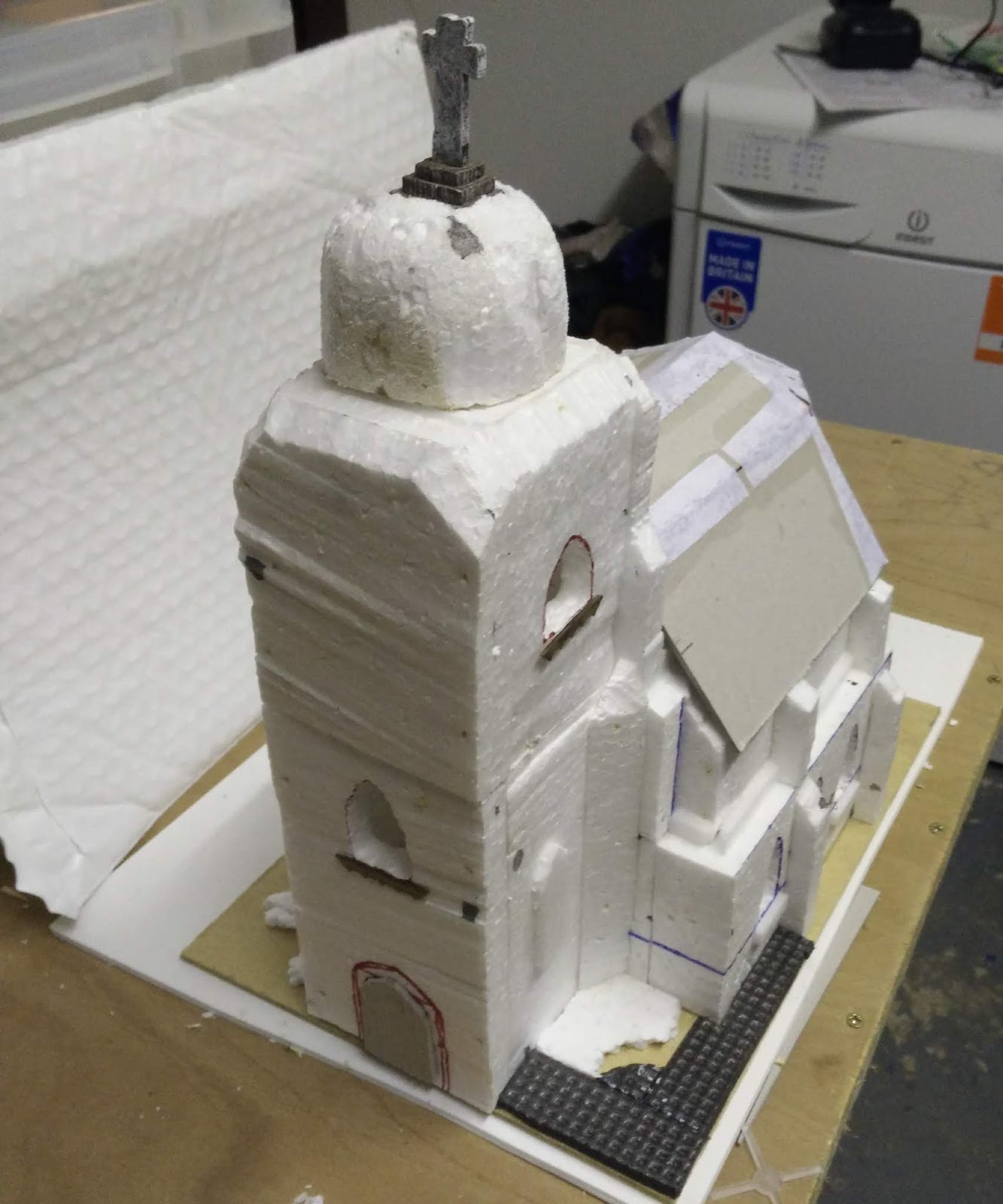
For a bit of variety (and to start learning about different materials) I am using polystyrene foam to make this. This is the cheaper expanded polystyrene rather than the denser extruded variety. The basic structure is made out of the foam by cutting slices off to create the walls and gluing them in place with some PVA and cocktail sticks to hold the sections together.


The main structure is finished off and then the roof is tackled. The sub-structure is from foam, carved to the basic shape and then with card panels glued into position. I glue paper over the seams of the card to give a smoother appearance. The top cross is actually a piece from Supreme littleness designs which I got a while back, thrown in for free when buying a selection of patrol markers from them.


Although at this stage I realised that it really needs another window in the front of the tower, up at the top. It just doesn't look right blank.


The whole thing is coated in black emulsion. This is partly to seal the foam but I think it will also help the next stage.


The next stage is of course smearing plaster (mixed/thinned slightly with PVA) everywhere. In some areas I tried to texture it a bit using a bit of soft packing foam, however I didn't get as much done as I would have liked as I got called away onto something else and it largely dried by the time I got back to it! The dangers of a hobbyist.


 In one corner I've added a bit of cobblestone, just etched foam, to add some detail and difference. The windows are not even, largely because I free-handed them, but it has made me think it would be useful to make a small jib/stencil that I could use as a template. I'll try even up the windows a little but I'm not going to spend too much time on it.


Once dried the whole thing got a good coat of a dark grey. This was followed by a range of other colours (yellow ochre, beige, sandstone, fresh barley) mainly tester pots, to try get a sandstone like finish. Strangely enough Sandstone is not quite sandstoney enough for my liking.


At this point I don't think it is too far away from the look I was aiming for. I think it needs a little more grey dry brushed on in some places, and probably a wash to tie it all together and weather it a little. And of course the roof to be finished.

It is pretty shoddy construction work, not flush, not at right angles but it has been thrown together quickly and it has given me some good ideas for the future in how to go about making some buildings out of foam. I also am running hard with Rich Clarke's philosophy of pieces not needing to be exact scale models but rather give the impression of the environment or building. That gives me suitable leeway to be as cackhanded as I am!

You can see the end of this build here.